
2026–27 CURRICULUM ROADMAP · GRADE 8 PHYSICAL SCIENCE

HANDS-ON. STUDENT-DRIVEN.
SCOPE & SEQUENCE

Aligned to the Georgia Standards of Excellence (GSE S8P1 through S8P5). A 179-day roadmap grounded in authentic phenomena, rigorous inquiry, engineering builds, and measurable student growth.
Course & Grade Physical Science · Gr 8
Instructional Time 179 Days
School Year 2026–27
Priority Standards GSE S8P1–S8P5
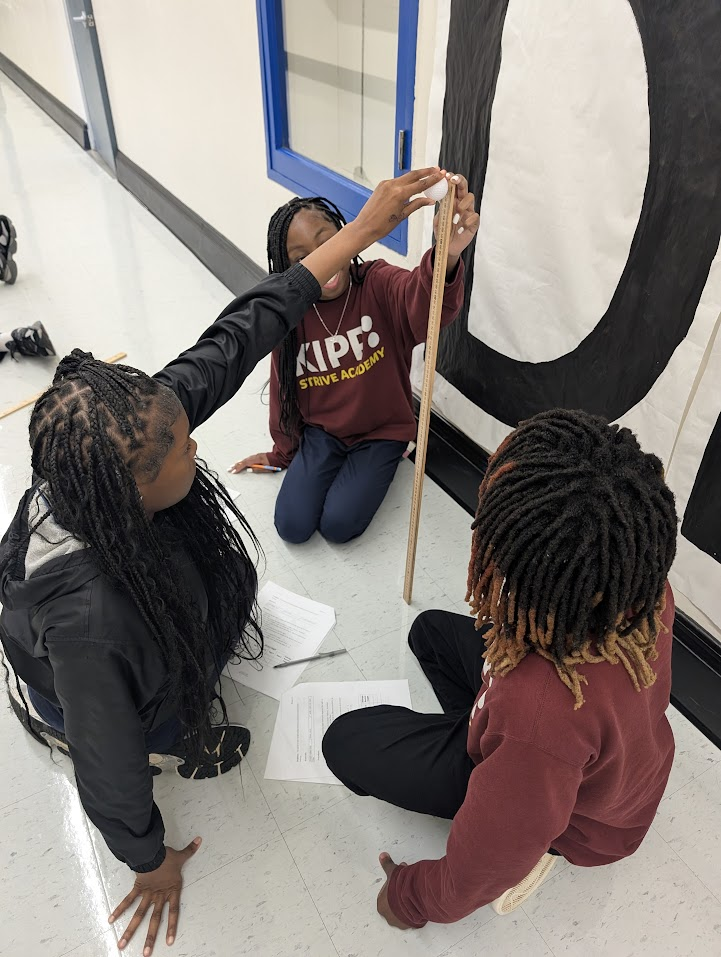
Students conducting hands-on scientific measurement lab in a ThinkeringBox classroom
GEORGIA STANDARDS ALIGNEDRigorous GSE inquiry, engineering design, and student data growth.
OUR METHOD: THE SPARK. THINK. TINKER. EXPLAIN. LEAD.

Every unit connects real-world phenomena directly to standards mastery and student leadership.

THE SPARK

Real-world driving phenomena that disrupt what students think they know.

THINK

Scholars ask questions, unpack big ideas, and model scientific systems.

TINKER

Hands-on builds, circuitry, and investigations that test hypotheses.

EXPLAIN

Connecting data to the standard. Defending claims with hard empirical evidence.

LEAD

Public showcase, peer mentoring, and ownership of their academic growth.

GRADE 8 PHYSICAL SCIENCE · 7-UNIT PACING ROADMAP

Explore each unit's instructional window, targeted Georgia Standards of Excellence (GSE), anchor phenomena, core objectives, and hands-on ThinkeringBox builds.

UNIT 1 28 INSTRUCTIONAL DAYS
Aug 3 – Sept 21

Structure and Properties of Matter

Focus: Atomic Structure, States of Matter, Chemical Reactions & Heat Transfer
📅 Unit Assessment: Sept 18
THE SPARK · ANCHOR PHENOMENA
  • Why does iron rust while gold does not?
  • Why does baking soda react violently with vinegar?
  • How is harmless table salt created from reactive sodium metal and toxic chlorine gas?

Scholars will investigate the structure and properties of matter by modeling atoms, elements, compounds, mixtures, and molecules; compare physical and chemical properties and changes; explain conservation of matter during chemical reactions; and analyze how thermal energy affects particle motion and energy transformations.

S8P1a-f: Structure & properties of matter; pure substances vs. mixtures; particle motion in solids/liquids/gases/plasma; chemical vs. physical properties; chemical changes; atomic models & periodic table; conservation of matter in reactions.
S8P2c-d: Law of conservation of energy; system energy transformations; heat transfer mechanisms on molecular motion (conduction, convection, radiation).
  • Inquiry Gas Evolution Lab: Balloon-flask chemical reaction tracking mass conservation.
  • 3D Molecular Modeling: Constructing covalent and ionic bond structures to visualize pure substances vs. mixtures.
atommoleculeelementcompoundmixturepure substancephysical propertychemical propertyphysical changechemical changeperiodic tableperiodgroupendothermicexothermicconservation of matterpHacidbaseneutralization
UNIT 2 20 INSTRUCTIONAL DAYS
Sept 22 – Oct 9

Interactions of Energy and Matter

Focus: Heat Transfer, Non-Contact Fields, Electricity & Electromagnetism
📅 Unit Assessment: Oct 8
THE SPARK · ANCHOR PHENOMENA
  • Why does a metal spoon get hot in soup significantly faster than a wooden spoon?
  • How does a microwave heat food through radiation without an open flame?

Scholars will investigate how energy is transferred and transformed within systems, explain heat transfer through conduction, convection, and radiation, and analyze how electric and magnetic forces interact through fields, conductors, insulators, and electromagnets to solve real-world problems.

S8P2c-d: System energy transformations; investigations of heat transfer via conduction, convection, and radiation on atomic collisions.
S8P5a-c: Gravitational, electric, and magnetic force fields acting at a distance; charge distribution in conductors and insulators; factors controlling electromagnet strength.
  • Thermal Insulation Chambers: Engineering containers that minimize conductive and radiative heat loss.
  • Electromagnet Solenoid Builds: Varying wire coil wraps and core materials to lift heavy metallic loads.
conductionconvectionradiationthermal energytemperatureelectromagnetic spectrumwavelengthfrequencyinfraredultravioletX-raygamma raynuclear fusionorbitgravitational attraction
UNIT 3 20 INSTRUCTIONAL DAYS
Oct 19 – Nov 13

Waves

Focus: Mechanical & Electromagnetic Waves, Optics, Sound & Technological Devices
📅 Unit Assessment: Nov 12
THE SPARK · ANCHOR PHENOMENA
  • Why does a straight straw appear bent or broken when submerged in water?
  • How do active noise-canceling headphones silence external sounds using destructive interference?
  • Why does an emergency vehicle siren noticeably shift pitch as it speeds past?

Scholars will investigate the behavior of mechanical and electromagnetic waves by analyzing wave properties, explaining the relationship between frequency, wavelength, amplitude, and energy, and exploring how waves transfer energy through light, sound, lenses, and technological applications.

S8P4a-g: Electromagnetic vs. mechanical waves; EM spectrum energy relationships; engineering practical EM devices; wave reflection, refraction, absorption, diffraction, and transmission; media density effects; optical lens properties.
  • Acoustic Resonance & Interference Tubes: Measuring sound wave nodes and frequency cancellation.
  • Refractive Telescope & Periscope Optics: Aligning convex and concave lenses to direct light beams.
wavelengthfrequencyamplitudetransverse wavelongitudinal wavemechanical waveelectromagnetic wavereflectionrefractiondiffractionabsorptionDoppler effectresonanceinterferencepitchvolumetimbre
UNIT 4 20 INSTRUCTIONAL DAYS
Nov 16 – Dec 18

Forces

Focus: Gravity, Planetary Orbits, Magnetic Fields & Non-Contact Interactions
📅 Unit Assessment: Dec 17
THE SPARK · ANCHOR PHENOMENA
  • Why do planets orbit the sun in ellipses rather than perfect circles?
  • How does Earth's invisible magnetic field shield our atmosphere from destructive solar winds?
  • How can a magnet repel and move an object through solid cardboard without physical touch?

Scholars will investigate how gravitational, magnetic, electrical, and frictional forces influence the motion of objects by analyzing force fields, interactions between charged particles and magnets, and the role of conductors and insulators while explaining how forces and energy work together within systems.

S8P5a-c: Differences between mass and weight; interactions among magnets, fields, and electricity; non-contact forces at a distance with conductors and insulators.
S8P1e & S8P2c: Atomic charge models and periodic table trends; energy transformation claims in dynamic systems.
  • Magnetic Levitation Guidance Tracks: Engineering balanced magnetic poles to suspend friction-free vehicle prototypes.
  • Gravity Orbital Trajectory Well: Simulating planetary mass and gravitational velocity using curved space fabrics.
gravitational forceorbitellipseelectromagnetic forcenuclear forcenuclear fusionfieldsolar windmagnetic fieldnon-contact forceradiationgravitational attraction
UNIT 5 47 INSTRUCTIONAL DAYS · COMPREHENSIVE MECHANICS
Jan 5 – March 19

Motion & Mechanical Systems

Focus: Newton's Laws of Motion, Kinetic vs. Potential Energy, Work & Simple Machines
📅 Unit Assessment: March 18
THE SPARK · ANCHOR PHENOMENA
  • Why does a roller coaster require its highest hill at the very beginning of the track?
  • What allows an orbiting satellite to travel at 17,500 mph for decades without consuming engine fuel?
  • Why do a bowling ball and a billiard ball hit the ground at the exact same instant when dropped in a vacuum?

Scholars will investigate the relationships among force, motion, speed, acceleration, and energy by analyzing data, applying Newton's Laws of Motion, comparing balanced and unbalanced forces, and explaining how kinetic and potential energy transform within moving systems.

S8P3a-c: Quantitative analysis of force, mass, and motion (F=ma); Newton's Three Laws of Motion; balanced vs. unbalanced net forces predicting changes in motion.
S8P2a-b: Graphical displays of kinetic energy to mass and speed; potential energy to mass and height; transformation between kinetic and potential energy in a closed system.
  • Kinetic Roller Coaster Prototypes: Engineering track loops and drops to calculate potential-to-kinetic energy conversion.
  • Newton's Inertia Crash Carts: Collecting photogate timer data to prove acceleration vs. mass relationships.
  • Compound Pulley & Lever Rigs: Calculating mechanical advantage and work efficiency.
velocityaccelerationspeedinertianet forcefrictiongravitybalanced forcesunbalanced forcesNewton's 1st LawNewton's 2nd LawNewton's 3rd Lawpotential energykinetic energyconservation of energyworkpowermechanical advantagesimple machineleverpulleyinclined planewheel and axle
UNIT 6 20 INSTRUCTIONAL DAYS
March 22 – April 23

Mastery Spiral & Performance Training

Focus: Cumulative Standards Spiral Review, Digital Learning Plans & GMAS Readiness
📅 Cumulative Post-Assessment
THE SPARK · ANCHOR PHENOMENA
  • How can a single real-world event simultaneously involve matter, energy transformations, wave transmission, forces, and motion?
  • Synthesizing and re-examining anchor phenomena from all 5 prior physical science domains.

Scholars will synthesize physical science principles across all GSE standards. Scholars analyze complex multi-step data sets, revise scientific models, and construct evidence-based arguments connecting Matter, Energy, Waves, Forces, and Motion.

S8P1 through S8P5: Complete cumulative spiral review of all 8th Grade Georgia Science Standards of Excellence in preparation for Georgia Milestones (GMAS) performance.
  • Multi-Variable Science Defense Labs: Scholars are given unlabelled phenomena and must identify and defend the physical laws in action.
  • Digital Learning Simulation Modules: Interactive computational modeling of complex energy transformations.

Cumulative review and mastery of all physical science domain terms from Units 1 through 5.

UNIT 7 24 INSTRUCTIONAL DAYS · CULMINATING SHOWCASE
April 26 – May 27

Project-Based Learning & ThinkeringBox Capstone

Focus: Student-Driven Inquiry, Engineering Iteration, Prototyping & Community Showcase
🏆 Public Capstone Defense
THE SPARK · ANCHOR PHENOMENA
  • Student-generated driving questions rooted in real-world physical science and local community challenges.
  • How can we apply principles of energy, forces, circuits, and motion to engineer solutions for modern problems?
  • Scholars will synthesize content from multiple units to investigate a student-generated essential question.
  • Scholars will evaluate real-world data and sources for scientific credibility and relevance.
  • Scholars will identify patterns and causal relationships across physical science phenomena and defend their working solutions.
S8P (Student-Driven): Student-selected integration of physical science standards through authentic project-based learning and peer leadership.
  • Grand Solar Car & Clean Energy Showcase: Designing, wiring, soldering, and racing optimized solar vehicles.
  • Public Capstone Defense: Scholars present empirical design data to judges, mentors, and community partners.
engineering designiterationprototypeconstraintscriteriaevidenceclaimreasoning

2026–27 YEAR AT A GLANCE · CURRICULUM SCHEDULE MATRIX

Complete 179-Day Pacing Breakdown Aligned to Georgia Standards of Excellence
179 DAYS TOTAL
Unit Unit Title Pacing Instructional Window Assessment Date Priority Standards Anchor Question
Unit 1 Structure & Properties of MatterAtomic models, substances & changes 28 Days Aug 3 – Sept 21 Sept 18 S8P1a-f, S8P2c-d Why does iron rust while gold does not?
Unit 2 Interactions of Energy and MatterHeat transfer, fields & electromagnets 20 Days Sept 22 – Oct 9 Oct 8 S8P2c-d, S8P5a-c Why does a metal spoon heat faster than wood?
Unit 3 WavesMechanical & electromagnetic wave properties 20 Days Oct 19 – Nov 13 Nov 12 S8P4a-g Why does a straw appear bent in water?
Unit 4 ForcesGravity, fields, mass vs. weight & orbits 20 Days Nov 16 – Dec 18 Dec 17 S8P5a-c, S8P1e, S8P2c Why do planets orbit in ellipses not circles?
Unit 5 Motion & Mechanical SystemsNewton's Laws, balanced forces & energy 47 Days Jan 5 – March 19 March 18 S8P3a-c, S8P2a-b Why does a coaster need a high first hill?
Unit 6 Mastery Spiral & PerformanceCumulative spiral review & GMAS readiness 20 Days March 22 – April 23 Cumulative S8P1–S8P5 Review Connecting matter, energy, waves & forces
Unit 7 Project-Based Learning CapstoneAuthentic inquiry, prototypes & defense 24 Days April 26 – May 27 Showcase S8P (Student-Driven) Student-generated driving questions

READY TO BRING THIS CURRICULUM TO YOUR CLASSROOM?

Partner with The ThinkeringBox to access complete lesson modules, lab materials, student engineering journals, and hands-on teacher training.

GET IN TOUCH